
Introduction
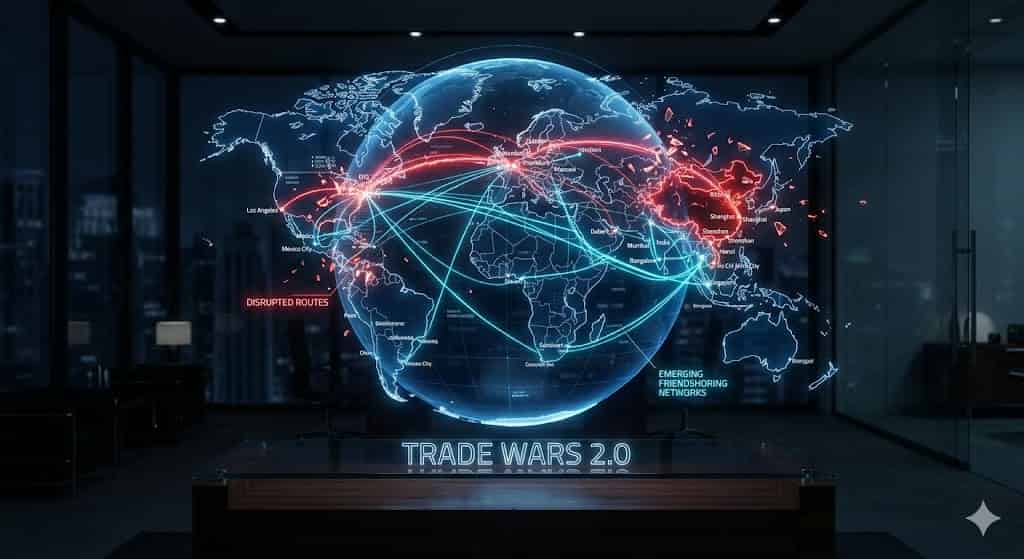
The global economic landscape is undergoing a seismic structural shift. The resurgence of aggressive protectionist policies, colloquially termed “Trade Wars 2.0,” marks a definitive departure from the hyper-globalized era that defined the late 20th and early 21st centuries. With the reintroduction and escalation of sweeping tariffs by the Trump administration, international trade frameworks are being rapidly rewritten. For businesses, this is no longer merely a political talking point or a temporary disruption; it is a critical, long-term operational variable.
The new tariff regime introduces unprecedented volatility, forcing multinational corporations to fundamentally reassess their global footprints. The assumption of frictionless, low-cost cross-border trade has been shattered. This article explores the deep strategic implications of these new tariffs on global supply chains and outlines how businesses must adapt to build resilience in an era of geopolitical fragmentation and economic nationalism.
The Mechanics of Trade Wars 2.0: Beyond Simple Protectionism
Unlike the initial trade skirmishes of the late 2010s, Trade Wars 2.0 are characterized by a broader, more calculated approach to economic decoupling. The focus has expanded well beyond simply addressing bilateral trade deficits. Today’s tariffs are weaponized instruments aimed at ensuring national security, maintaining technological supremacy, and driving domestic industrial revitalization.
The new tariffs are not just punitive taxes; they are designed to forcibly reroute global supply networks away from geopolitical rivals. This environment creates a complex matrix of compliance, cost forecasting, and logistical challenges. Supply chain managers are now operating in a landscape where tariff rates can fluctuate wildly based on executive orders, and entire regions can suddenly become unviable sourcing hubs overnight.
Key Strategic Impacts on Global Operations
The imposition of these new tariffs triggers a domino effect across international logistics and manufacturing. We can observe three primary strategic shifts occurring in real-time:
1. The Acceleration of Nearshoring and Friendshoring The most visible consequence of the new tariff structures is the mass exodus of manufacturing from traditional mega-hubs, particularly China. However, reshoring production entirely back to the United States or Europe is often economically unfeasible due to labor costs and skills shortages. As a result, companies are aggressively pursuing “nearshoring” (moving production to geographically closer countries like Mexico) and “friendshoring” (relocating to politically allied nations like Vietnam, India, or Eastern Europe). This requires massive capital expenditure to build new infrastructure and develop local vendor ecosystems from scratch.
2. Margin Compression and the Pricing Dilemma Tariffs are fundamentally a tax on imports, directly inflating the Cost of Goods Sold (COGS). Companies are caught in a difficult dilemma: absorb the added costs and suffer margin compression, or pass the costs onto the end consumer and risk losing market share in a highly inflationary environment. Strategically, businesses are being forced to re-engineer their products, finding ways to substitute tariff-heavy materials with alternative components, or completely redesigning their value propositions to justify higher price points.
3. The Shift from “Just-in-Time” to “Just-in-Case” For decades, the “Just-in-Time” (JIT) model dominated supply chain management, optimizing for maximum efficiency and minimal inventory holding costs. Trade Wars 2.0 has exposed the fragility of JIT. The unpredictability of tariff implementations and retaliatory measures means that waiting for components is now too risky. Companies are transitioning to a “Just-in-Case” methodology, holding larger buffer stocks and maintaining redundant suppliers. While this ensures business continuity, it ties up massive amounts of working capital and requires more sophisticated warehouse management strategies.
Actionable Strategies for Supply Chain Resilience
To survive and thrive in this fragmented global economy, passive observation is not an option. Companies must adopt proactive, technology-driven strategies:
- Deep-Tier Supply Chain Mapping: It is no longer enough to know your direct (Tier 1) suppliers. Tariffs often target specific raw materials or sub-components. Companies must achieve complete visibility into Tier 2 and Tier 3 suppliers to uncover hidden geopolitical and tariff risks embedded deep within their supply chains.
- AI and Predictive Analytics: Utilizing artificial intelligence to model various tariff scenarios is becoming a standard practice. AI-driven platforms can simulate how a sudden 20% tariff on a specific region would impact overall profitability, allowing management to preemptively shift sourcing before the policy even takes effect.
- Dynamic Sourcing Ecosystems: Contracts must be rewritten to allow for maximum flexibility. Instead of relying on a single, low-cost supplier, businesses must maintain a portfolio of approved, global vendors. This dynamic ecosystem allows procurement teams to swiftly pivot purchasing volumes based on whichever region currently offers the most favorable tariff and tax environment.
Conclusion
The era of frictionless global trade is currently suspended, replaced by a highly fragmented, heavily regulated, and fiercely competitive international marketplace. Trump’s new tariffs under the “Trade Wars 2.0” paradigm are not temporary anomalies; they are indicators of a long-term structural realignment in how global business is conducted.
For companies looking to maintain their competitive edge, the mandate is clear: agility and resilience must be baked into the very core of operational strategies. Supply chains can no longer be viewed strictly as back-office cost centers. In this new geopolitical reality, a robust, diversified, and technologically advanced supply chain is the ultimate strategic advantage. Organizations that recognize this shift and invest in structural flexibility will be the ones that dominate the markets of tomorrow.