
By Strategy Lab
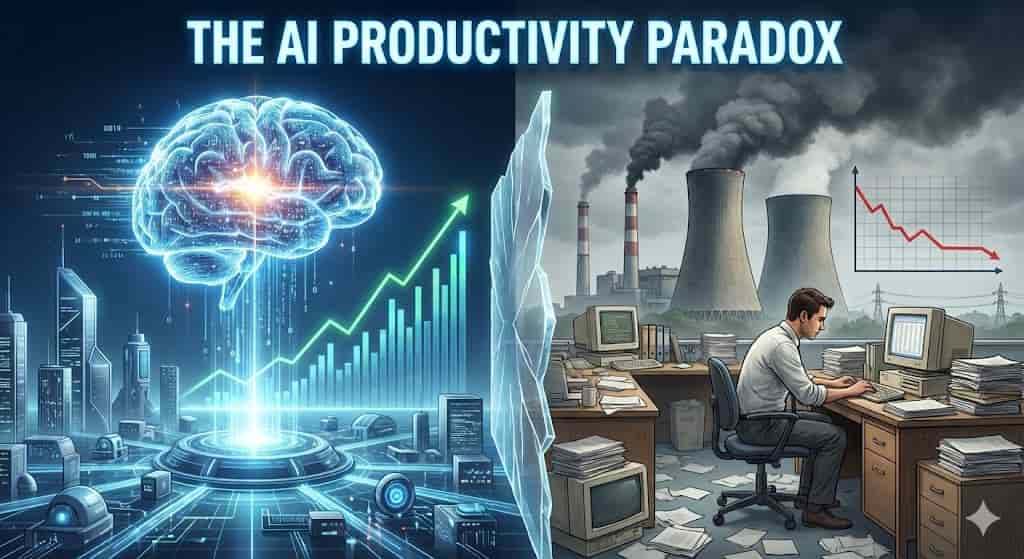
If you look at global stock indices in 2026, the narrative is overwhelmingly clear: Artificial Intelligence has won. Valuations for chipmakers, cloud providers, and foundational AI labs have reached unprecedented highs. Yet, if you look at macroeconomic indicators—specifically global productivity growth—a glaring disconnect emerges.
We are living through the AI Productivity Paradox.
Much like economist Robert Solow famously quipped in 1987, “You can see the computer age everywhere but in the productivity statistics,” the same is now true for advanced AI. While generative models can instantly write code, draft contracts, and generate video, seamlessly integrating these capabilities into legacy enterprise systems is proving to be a monumental bottleneck.
The transition from “AI as a novelty” to “AI as the core engine of global GDP” is exposing severe structural friction across energy markets, labor forces, and international regulations.
The Energy Bottleneck: AI’s Collision with Climate Goals
The most immediate physical constraint on the AI revolution is not silicon; it is electricity. The compute required to train and run next-generation multimodal models has grown exponentially, transforming the data center industry into a massive, energy-hungry monolith.
In 2026, grid capacity is struggling to keep pace. Hyperscalers are competing not just for land, but for guaranteed access to gigawatts of power. This is creating a direct conflict with global ESG (Environmental, Social, and Governance) commitments. As nations push to decarbonize, the relentless energy demands of AI data centers are extending the lifespans of coal and natural gas plants, while simultaneously monopolizing local renewable energy output.
For global markets, this means the cost of AI compute is heavily tethered to the volatility of global energy prices.
Regulatory Fragmentation: The Splinternet of AI
As multinational corporations attempt to deploy AI tools globally, they are slamming into a fractured regulatory landscape. The world has broken into three distinct AI governance models:
- The European Union (The Compliance Model): With the enforcement of the EU AI Act, Europe has prioritized risk mitigation and human rights. While setting the global standard for AI safety, the heavy compliance burden has slowed the deployment of enterprise AI across the continent, forcing companies into costly auditing processes.
- The United States (The Market-Driven Model): The US continues to favor an innovation-first approach, relying on a patchwork of agency guidelines rather than sweeping federal legislation. This allows for rapid commercialization but leaves enterprises navigating a minefield of copyright lawsuits and state-level data privacy laws.
- China (The Sovereign Integration Model): China’s approach aligns AI development directly with state industrial goals, heavily prioritizing the integration of AI into physical manufacturing, logistics, and supply chain optimization over consumer-facing generative text.
This regulatory divergence means there is no longer a “one-size-fits-all” enterprise AI strategy. Global companies are now forced to build localized, geofenced AI systems, severely limiting the scale and efficiency promised by the technology.
The Labor Reality: Displacement vs. Enhancement
The initial panic that AI would completely automate away the human workforce has matured into a more nuanced reality: AI replaces tasks, not necessarily entire jobs.
However, the disruption is highly concentrated. Unlike previous waves of automation that hollowed out blue-collar manufacturing, the 2026 AI wave is squarely targeting middle-tier, white-collar knowledge work—legal research, junior coding, copywriting, and administrative analysis.
The paradox here is that while companies are shedding redundant cognitive labor, they are desperately bottlenecked by a shortage of “AI-fluent” talent who can orchestrate these new systems. We are seeing simultaneous layoffs and talent wars within the exact same enterprise departments.
Conclusion: The Integration Phase is the Hardest Phase
The invention phase of the AI revolution is largely over; we have entered the integration phase, and it is proving to be messy, expensive, and slow.
For business leaders and investors, the key takeaway is that the true economic value of AI will not be captured by the companies simply buying the most software licenses. The winners in this decade will be the organizations that can fundamentally re-engineer their internal workflows, secure localized energy and compute resources, and navigate an increasingly hostile and fragmented global regulatory map.