
By Strategy Lab
For the past three decades, global supply chains were built on a single, governing principle: economic efficiency. Corporations chased the lowest labor costs and just-in-time logistics, creating a highly interconnected, yet deeply fragile, global network.
By 2026, that era has officially ended.
Driven by the ongoing technological cold war, the race for semiconductor sovereignty, and the aftershocks of global disruptions, the calculus has fundamentally changed. Today, the driving force of global trade is no longer cost-efficiency, but resilience and national security.
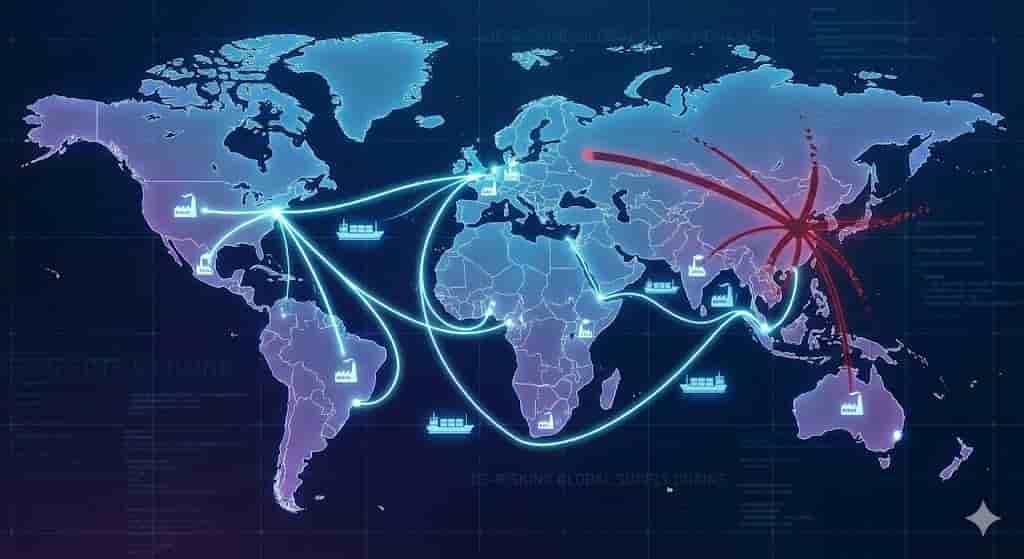
As political rhetoric often throws around the idea of total economic “decoupling” between the East and West, the reality on the ground is far more nuanced. We are witnessing the era of “de-risking”—a strategic, surgical rewiring of the global supply chain architecture. Here is how this new geopolitical reality is reshaping global business.
The Critical Minerals Race: Securing the New Oil
You cannot dominate the 21st-century economy without controlling the foundation of modern technology: semiconductors, electric vehicle (EV) batteries, and renewable energy infrastructure. Consequently, the geopolitical chessboard has shifted toward the control of critical minerals.
Nations are aggressively competing to secure steady supplies of lithium, cobalt, graphite, and rare earth elements. Historically, processing these materials has been heavily concentrated in specific regions, creating a massive single point of failure for Western tech and auto companies.
In response, 2026 has seen a surge in state-sponsored investments in domestic processing facilities and strategic partnerships with resource-rich nations in Africa and South America. Access to these minerals is no longer just a procurement issue; it is a matter of foreign policy and strategic leverage.
Nearshoring and Friendshoring as Strategic Imperatives
To mitigate geopolitical risks, multinational corporations have rapidly accelerated their departure from the “single-factory-to-the-world” model. The “China Plus One” strategy has evolved into “China Plus Many,” leading to the rise of nearshoring and friendshoring.
This architectural shift is creating new global manufacturing hubs:
- Mexico: Benefiting massively from its proximity to the United States and the USMCA framework, Mexico has become the premier nearshoring destination for automotive and aerospace manufacturing, effectively bypassing trans-Pacific shipping risks.
- India: With aggressive government incentives and a massive labor force, India is positioning itself as the new anchor for consumer electronics and pharmaceutical manufacturing.
- Vietnam and Southeast Asia: These regions have captured the overflow of semiconductor testing, packaging, and textile manufacturing, offering a strategic middle-ground in the Indo-Pacific.
These shifts are not temporary. They represent hundreds of billions of dollars in sunk capital and long-term infrastructure commitments.
The Macroeconomic Reality: The Cost of Resilience
While de-risking makes strategic sense, it comes with a steep price tag. Building redundant supply chains, relocating manufacturing to higher-cost regions, and maintaining larger inventory buffers fundamentally break the “just-in-time” model that kept global inflation low for decades.
The cost of resilience is structural inflation.
Corporate boards are now forced to accept that mitigating geopolitical risk hurts short-term profit margins. Companies must duplicate facilities, navigate fragmented regulatory environments, and train new workforces in emerging hubs. However, business leaders now view these costs not as operational inefficiencies, but as necessary insurance premiums against catastrophic geopolitical disruptions.
Conclusion: Supply Chains as Geopolitical Assets
The global economy of 2026 is defined by strategic fragmentation. Total decoupling remains an economic impossibility—the economies of the US, Europe, and China are still deeply entwined. However, the architecture of how goods, technology, and materials move between them has been permanently altered.
For modern enterprises, the lesson is clear: Supply chain management can no longer be relegated to the back office. It is a core component of corporate strategy and geopolitical risk management. The companies that will dominate the next decade are those that adapt fastest to this new, fragmented reality.